Through responsible corporate governance, we ensure our Board can effectively deliver long-term benefits to Lam and its stakeholders.
Sound governance is the foundation of our success. Our corporate governance program establishes clear processes, priorities, and responsibilities that support the company’s business and ESG goals.
The highest levels of our leadership are involved in our governance approach. Our Board of Directors aims to foster and maintain responsible and effective corporate governance practices to enhance the company’s success while mitigating risks. With an eye toward continuous improvement, our Board and management periodically review and update the company’s corporate governance policies and procedures.
Corporate governance documents
Ensuring Board effectiveness
As part of the Board’s commitment to responsible corporate governance, we have developed a number of practices to ensure Board effectiveness:
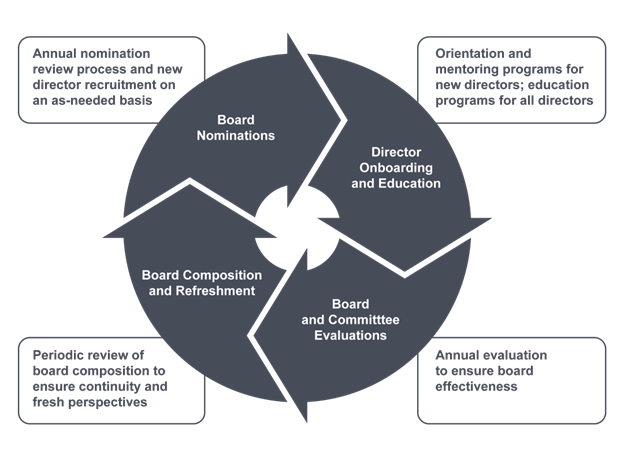
Board nominations
Annual nomination review process and new director recruitment on an as-needed basis
Director Onboarding and Education
Orientation and mentoring programs for new directors; education programs for all directors
Board and Committee Evaluations
Annual evaluation to ensure board effectiveness
Board Composition, Diversity and Refreshment
Periodic review of board composition to ensure continuity and fresh perspectives
Lam's ESG governance program at a glance
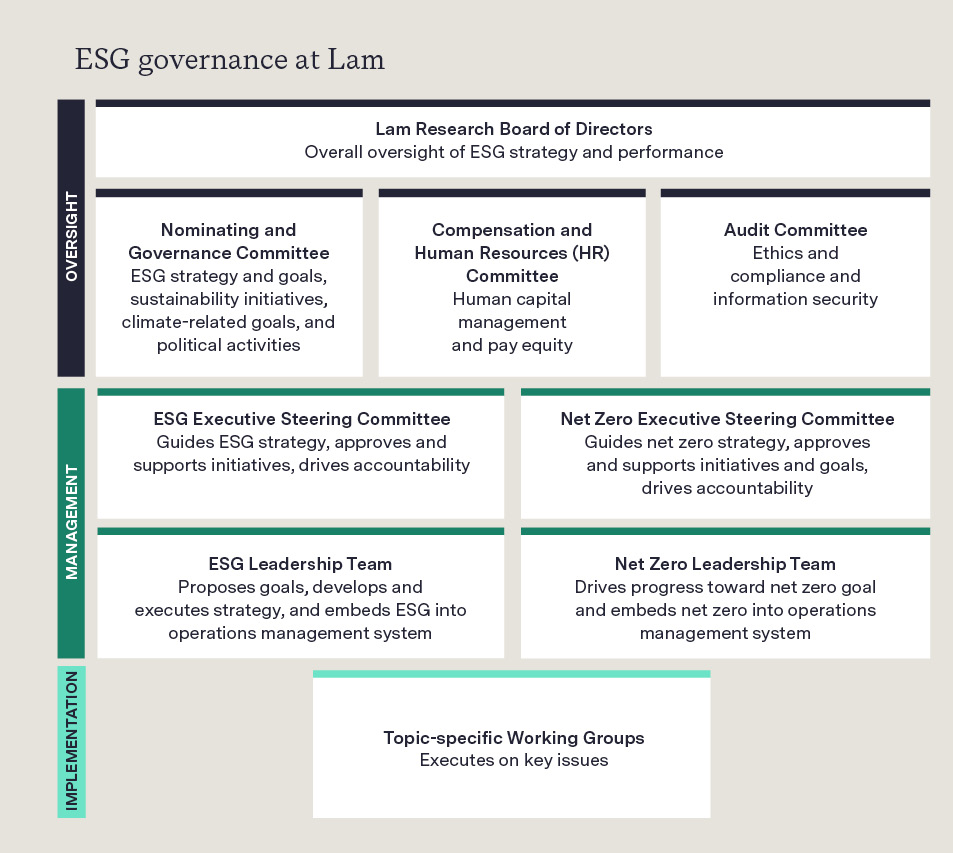
Oversight
Lam Research Board of Directors: Overall oversight of ESG strategy and performance
Nominating and Governance Committee: ESG strategy and goals, sustainability initiatives, climate-related goals, and political activities
Compensation and Human Resources Committee: Human capital management and pay equity
Audit Committee: Ethics and compliance and information security
Management
ESG Executive Steering Committee: Guides ESG strategy, approves and supports initiatives, drives accountability
Net Zero Executive Steering Committee: Guides net zero strategy, approves and supports initiatives and goals, drives accountability
ESG Leadership Team: Proposes goals, develops and executes strategy, and embeds ESG into operations management system
Net Zero Leadership Team: Drives progress towards net zero goal and embeds net zero into operations management system
Implementation
Topic-Specific Working Groups: Execute on key issues
Information Security
Lam’s entire value chain is powered by innovation. Our company and customers succeed by accelerating the development of novel and disruptive ideas. This makes our ability to safeguard the intellectual privacy and data of our employees, customers, and suppliers essential. By investing in our Information Security program, we seek to retain our customers’, suppliers’, and employees’ trust and maintain our company’s competitive edge.
Our Information Security program includes three pillars:
- Product security and engineering to enhance security as we develop products and applications.
- Governance, risk and compliance, and identity access management for internal and external users and access control.
- Security Operations Center through which we detect, analyze, and respond to potential cybersecurity threats.
Management and governance
Our chief information security officer leads our Information Security program and regularly provides updates to the Board. We continually work to improve our program by collaborating with world-class industry peers, global security researchers, and internal groups to focus on business resiliency, engineering, manufacturing, IT, and more.

Engaging our suppliers and employees in information security best practices
Lam holds ISO 27001 certification for information security at our corporate headquarters. We screen our suppliers for information security controls in order to protect our information, as well as that of our suppliers.
Our employees play a critical role in protecting and preserving data and information, so we work to educate them on strategies to avoid cyber threats and phishing schemes. Our employees participate in a mandatory, annual information security training. We also conduct periodic tests with our user population to reinforce best information security practices.

Government Affairs
We contribute our expertise and insight to inform sound public policy in support of our industry and business. Our Global Trade and Government Affairs (GTGA) group is responsible for Lam’s strategic engagement with international and domestic policymakers, including congressional and regulatory bodies at the local, state, federal and international levels. The GTGA group focuses on:
- Business and trade enablement
- Export controls and trade policy
- Industrial base policy
- Tax policy
- Public policy
Management and governance
Our GTGA group is led by our corporate vice president of global trade and government affairs, who is responsible for reporting to Lam’s Nominating and Governance Committee at least quarterly on political activities and annually on the Company's political policy updates and payments to trade associations as well as other third parties that may be used for political or lobbying purposes. Our lobbying and political activities are governed by our Code of Conduct, as well as our Political Activity and Government procedure. As a matter of company policy, Lam makes no direct political contributions of any kind to political parties, candidates, or political committees, nor does Lam make payments to influence the outcome of ballot measures, engage in independent political expenditures in direct support of or opposition to candidates, or engage in indirect political spending, such as through its supply chain, consultants, or third-party political organizations, including 501 (c)(4) or 527 entities. For more details, please refer to our Public Policy Engagement and Political Activity statement.

Global taxation management and governance
Our approach to global taxation is to consistently seek to comply with all legal, regulatory, and internal control requirements. Through this approach, we support our business and commercial strategy while ensuring that we use our best efforts to:
- Adhere to all applicable global tax laws, filings, and reporting disclosures.
- Account for tax risks in accordance with the applicable accounting standards and have internal controls in place over our tax reporting processes.
- Align our transfer pricing policies with the guidelines of the Organization of Economic Co-operation and Development, and with all jurisdictions in which we operate.
- Apply the “arm’s length” principle when conducting intercompany transactions.
Replacing per- and polyfluoroalkyl substances (PFAS)
The semiconductor industry relies on PFAS chemistries and materials for a wide variety of critical applications across the value chain. While Lam does not manufacture PFAS, PFAS material may be found in our products, used as process chemicals, or created as byproducts within our or our customers’ R&D activities.
Lam's PFAS statement is available to customers upon request.
Caution Regarding Forward-Looking Statements
Statements made on our Company webpage that are not of historical fact are forward-looking statements and are subject to the safe harbor provisions created by the Private Securities Litigation Reform Act of 1995. Such forward-looking statements relate to, but are not limited to: our goal to be net zero by 2050, our ESG strategy and related goals, our renewable electricity goals, our continued commitment to business integrity, the strength and effectiveness of our ethics and compliance framework, our environmental footprint, sustainability in our industry, our social impacts, and the sustainability of our products and operations. Some factors that may affect these forward-looking statements include: trade regulations and tariffs, export controls, trade disputes, and other geopolitical tensions may inhibit our ability to sell our products; business, political and/or regulatory conditions in the consumer electronics industry, the semiconductor industry and the overall economy may deteriorate or change; the actions of our customers and competitors may be inconsistent with our expectations; supply chain cost increases and other inflationary pressures have impacted and may continue to impact our profitability; supply chain disruptions or manufacturing capacity constraints may limit our ability to manufacture and sell our products; and natural and human-caused disasters, disease outbreaks, war, terrorism, political or governmental unrest or instability, or other events beyond our control may impact our operations and revenue in affected areas; as well as the other risks and uncertainties that are described in the documents filed or furnished by us with the Securities and Exchange Commission, including specifically the Risk Factors described in our most recent annual report on Form 10-K and our quarterly report on Form 10-Q. These uncertainties and changes could materially affect the forward-looking statements and cause actual results to vary from expectations in a material way. The Company undertakes no obligation to update any forward-looking statements.
Additionally, while we leverage various frameworks and other standards in our disclosures, such standards are ultimately only used to inform our disclosures and we cannot guarantee (and no language of “alignment” or similar should be understood to mean) complete adherence to such standards or any particular stakeholders’ interpretation of same. Our disclosures based on standards may change due to revisions in framework requirements, availability or quality of information, changes in our business or applicable governmental policies, or other factors, which may be within or outside of our control. Similarly, some of the information in this Report is reliant on third-party information or methodologies. Any inaccuracies or changes in such information or methodologies, whether within or outside of our control, could cause results and performance to differ from what is reported. In addition, various aspects of this report are based on processes and procedures that we believe apply appropriate levels of support to address issues in scope and, while these statements may use words such as “ensure”, “prevent”, or similar language, such terms should not be considered to mean (as there can be no guarantee) that such efforts will be successful in all situations.
Separately, certain information included in this Report may be used for compliance with various legal obligations; however, this Report is necessarily broader than certain legal requirements, and any such use shall not be deemed to incorporate portions of this Report that are not responsive to such obligations or references to same. It is not intended, and we hereby disclaim, any legal relations, rights or obligations to any third-party in connection with these disclosures. Moreover, by providing this information, neither we nor any of our affiliates are conceding any specific item is required or applicable under any legal obligation, nor are we conceding any particular interpretation of such legal requirements. Moreover, in certain circumstances, information included in this Report may differ from information included in regulatory reporting due to differences in methodologies for the calculation of certain metrics or other factors, which may be within or outside of our control.